

Cocoon nebula, surrounded by a dark nebula, reddening and blocking light from background Milky Way stars.
Cocoon nebula, surrounded by a dark nebula, reddening and blocking light from background Milky Way stars.
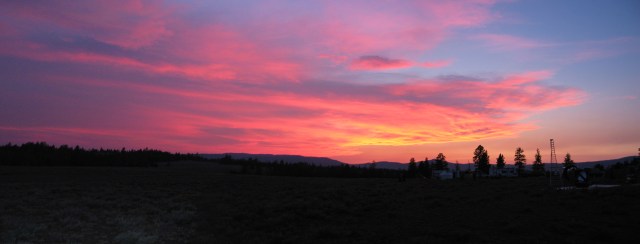
Striking colors at the Oregon Star Party
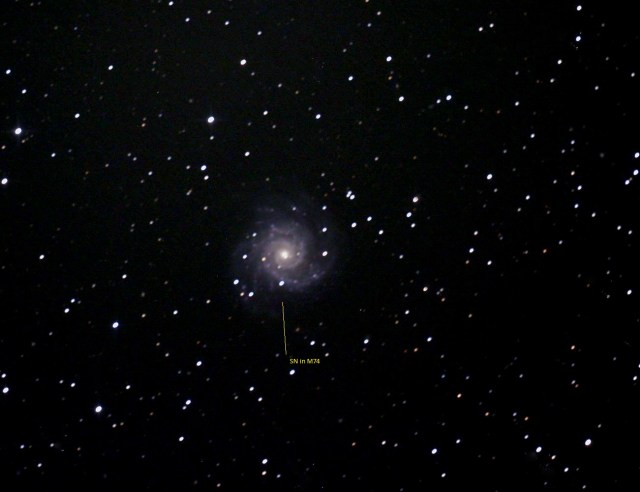
This shows a supernova, less than a week old, in galaxy M74 in Pisces. It is about magnitude 12.5, and about the same brightness as the core of the galaxy.
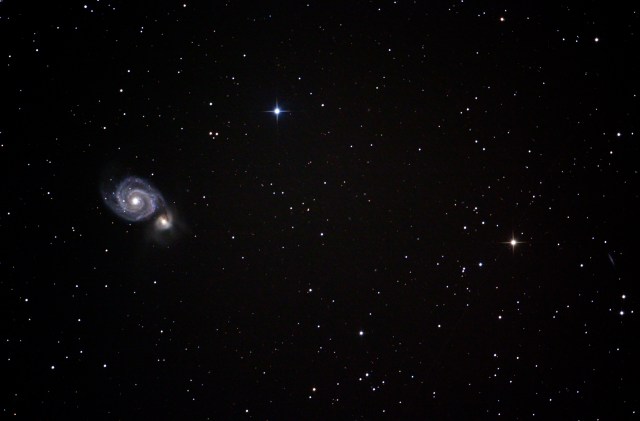
The Whirlpool Galaxy and its gravitationally-interacting companion. (also a faint edge-on galaxy at far right) Combination of 25 exposures of 200 seconds each, at ISO 3200, with Canon 60Da, through 8″ f/4 Newtonian, at 2013 Oregon Star Party. Captured with MaximDL, guided with PHD, stacked with CCDStack, contrast stretched (e.g. curves) in Photoshop CS6.
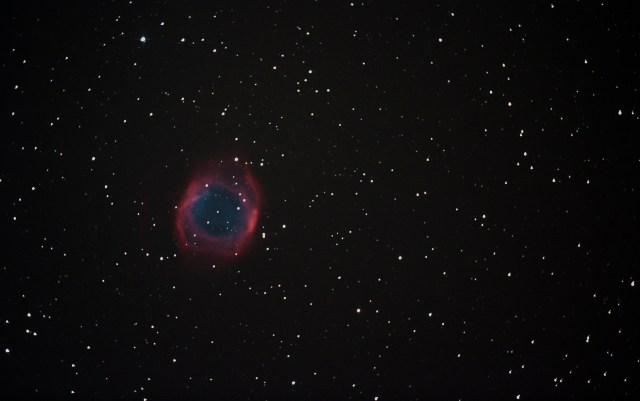
About the closest ‘planetary’ nebula to Earth, which makes it appear almost half as large as the moon on the sky, but light is spread thinly, so needs a dark sky (like OSP) to be seen well. 30 x 200 second exposures, ISO 3200, Canon 60Da, 8″ f/4 scope, from OSP 2013 in Ochocco Nat. Forest in Oregon.

Face-on spiral galaxy with interesting kinked spiral arm structure. Moderately close and large on the sky, with medium surface-brightness in amateur telescopes. 25 exposures 200 seconds, ISO 3200, Canon 60Da, AstroTech AT8IN 8″ f/4 Newtonian, Losmandy G11 mount, PHD guiding, captured with MaximDL, stacked with CCDStack, final editing with Photoshop CS6.

This very young group of hot blue stars is surrounded by dust which reflects the blue light of the stars. It is one of the closest of open clusters to Earth, and is easily visible to the unaided eye in the autumn and winter sky. Image taken with Canon 60Da DSLR camera, on 8″ f/4 AstroTech imaging newtonian telescope with coma-corrector.
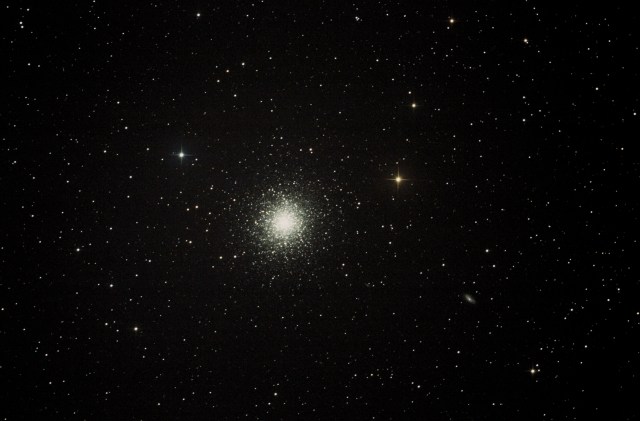
This spherical collection of 100k to 1M ancient metal-poor stars is one of the most often observed summer objects in the northern hemishpere, and glitters like diamond dust in the eyepiece. Photo taken with Canon 60Da DSLR, multiple exposures, through 8″ f/4 AstroTech AT8IN newtonian with coma-corrector

Star clusters are very sparkly through the eyepiece, but tend to look flat in photos. This large double cluster requires a very wide field of view. Taken with Canon 60Da DSLR camera, combination of multiple exposures, through an 8″ f/4 AstroTech AT8IN newtonian telescope with coma-corrector.
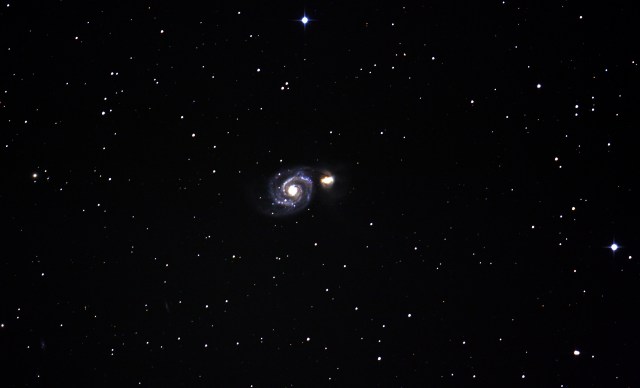
M51 face-on spiral near handle of Big Dipper. Taken Jul 28 2011, with Canon 20Da camera on 8″ f/4 AstroTech AT8IN newtonian

NGC 891, multiple exposures at Oregon Star Party, with Canon 60Da through 8″ f/4 AstroTech AT8IN newtonian, with coma-corrector.
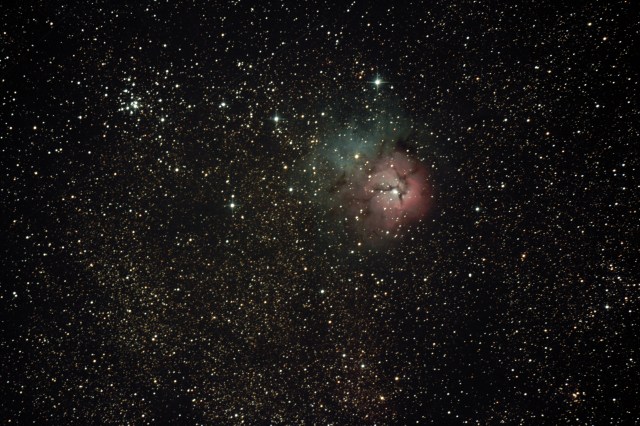
Trifid Nebula, showing both hydrogen-alpha (red) emission, and dust reflection (blue) nebulosity. Taken at Oregon Star Party, with Canon 60Da and 8″ f/4 AstroTech AT8IN newtonian with coma-corrector.

California Nebula, from Oregon Star Party, taken with Canon 60Da through 8″ f/4 AstroTech AT8IN newtonian
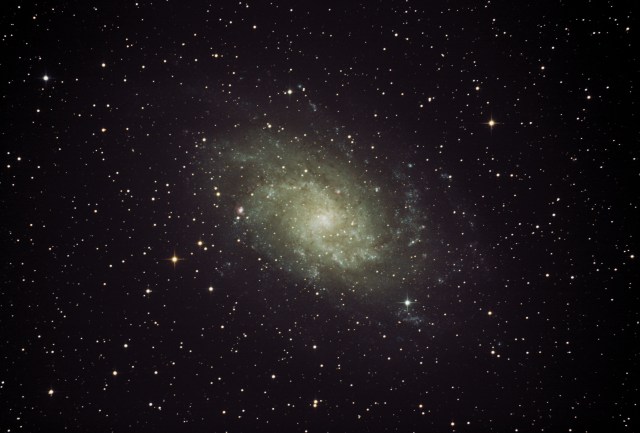
From Oregon Star Party, Canon 60Da and 8″ f/4 AstroTech AT8IN newtonian

Large bright edge-on galaxy visible in the spring in Canes Venatici. Taken at Camp Delany Apr 11 2013, multiple 60-sec exposures at ISO 1600 with Canon 60Da, and 8″ f/4 AstroTech AT8IN newtonian telescope

A classic spring trio of galaxies, and a supernova to boot! Taken Apr 11 at Camp Delany, with Canon 60Da, multiple 60-sec exposures at ISO 1600, with an 8″ AstroTech AT8IN newtonian, on G11 mount. Images combined in MaximDL5. Curves, contrast, color-balance processing in PS CS6. SN 2013am is visible in M65 (lines).
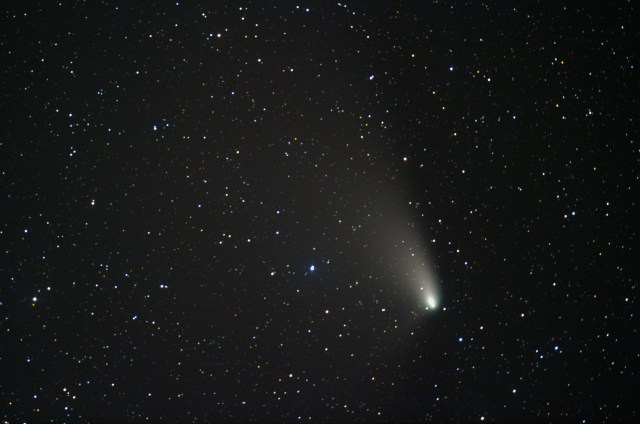
Comet PanSTARRS was circumpolar at this time; taken in early am of Apr 11, with Canon 60Da, 10x 60sec, 1600 ISO, with an 8″ f/4 AstroTech AT8IN newtonian, coma-corrector, on G11 mount
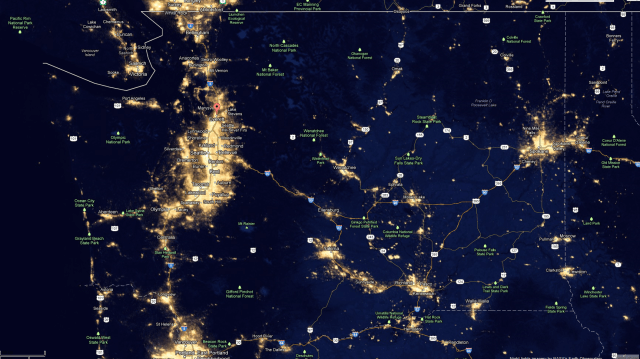
This is essentially the view from space over Washington State – from Blue Marble. From any of the glowing areas, (where the people are) it is very hard to see the night sky.
Frogs and Galaxies
Growing up with a love of astronomy, I have spent uncounted hours at night outside in rural and suburban areas, observing the sky with binoculars, telescopes, and simply laying back and taking it in with just my eyes. This also allows my other senses to experience a rich connection to the outdoor world. Being outside, with the sky’s clockwork wheeling overhead, and with the sounds and smells of the outdoors available to my senses completely eliminates the need of a calendar to tell me what season is at hand.
The changing of winter into spring is announced by a swelling chorus of the tree frogs, the soft scent of the earliest flowers and shrubs, and by the great cat Leo in the south and the Great Bear high in the northeast soon after dark. Tonight the waxing crescent moon rides very high in the west, above the fringe of bare trees, instead of gliding through them as in other months. In recent years, the most dynamic of sights in my telescope — Jupiter — has appeared in the evening at this time.
As the sky fully darkens, somewhat later now each night, pointing the telescope to the southeast finds an area poor in stars, but rich with clouds of galaxies. The Virgo and Coma Bernices clusters of galaxies show a confusing number of somewhat faint patches of light to my 8-inch telescope — I still often come across a galaxy unexpectedly in my eyepiece without knowing its name until I can scrutinize its placement relative to nearby stars and check my atlas. If the sky is dark enough, many are recognizable by their individual appearance or by their grouping with nearby neighbors. Some are soft round shapes, others oval with hints of structure, others needle-like, seen edge-on. Some, like M86 and M87, are massive and bright; others barely perceptible at all.
Spring has grown to be my favorite season — filled as it is with rebirth, renewal, and possibilities — the return of warmth and color, and the reassurance that the cycles of life continue unabated, just as all the treasures in the sky unerringly return to be savored again. The frogs singing to each other is a wonderful part of the spring night — sometimes I close my eyes momentarily at the telescope just because I become aware that I have been so absorbed in examining a faint spot of light that the melodic sound has gone unnoticed. Frogs and galaxies have formed links in my mind.
The warmth, fragrance and repeated songs all combine to set a calm and tranquil mood. They hint at primeval connections to nature — they satisfy us by touching deep within the amphibian part of our brain. The galaxies at their immense untouchable distance also reinforce a calming message about the unimportance of day-to-day problems, by showing the scale of our surroundings. On rainy nights when the galaxies are only visible in books, the frogs still provide a pleasant ambiance.
Because of the geometry of the solar system, and my location on the earth, the spring galaxies have a short evening apparition. They progress from being visible only in the middle of the night to being overtaken by the glow of the lengthening day in what seems a short span of weeks, as the sunset and ever more persistently lingering evening twilight rapidly eat up the sky to the west of them. The frogs’ song, in concert, also rapidly reaches a crescendo and then, much sooner than I would like, fades away into the globular clusters of summer. Sometimes it is replaced by the crickets and their rhythmic thermometric chirps — but to me, they are only the understudies.
A portion of the evolution of frogs is coincident in time with the 50-million-year flight of photons from the Virgo galaxies — for four times longer than the light has taken on its journey, the frogs have been here. The light travel time from the closest major galaxy of all (the Andromeda galaxy M31, visible in Autumn) has allowed 2.2 million years of frog evolution to occur — and perhaps all of man’s. Only the Magellanic clouds (minor galaxies, interacting directly with our Milky Way) are close enough to have sent their light since man walked fully upright and approached that which we call ‘modem’.
The places that provide the best views of the faint smudges of ancient light tend to be the best places to hear the frog symphony — in pastoral rural fields or remote mountain venues, far from the spill of light and noise of urban life. I recall a camping trip to a lake near Mt. Adams where I saw the brief orange prominence of nova Cygni 1976 in binoculars as I lay looking up through the rich plane of our own Milky Way galaxy from my sleeping bag, and how all along the mountain roads nearby at that time, there were uncountable numbers of frogs or toads involved in a massive nighttime cross-country migration, believed to be guided, in part, by the stars.
Galaxies intrigue me because they are the most tangible objects that help us to realize the concept of infinity — they challenge our comprehension with such vast numbers, distances, and energies. The hierarchy of town, country, planet, solar system, star cluster, galaxy, cluster, super-cluster, universe — is only able to be personally confirmed out to the Virgo cluster, directly visible in a telescope. A single field of stars in our own local region of the Milky Way can be breathtaking in number — a major galaxy can have a few hundred billion, and the galaxy clusters show hundreds of these almost imperceptible individual Milky Ways. It almost demands a momentary pause of awe, as each magnitude is allowed to register.
Near my home in the outer fringe of suburbs, where I most often observe, there is a pond and streams that seem to provide habitat for frogs. The nearby lots are large and wooded, but there are also driveways and cats and lawns all around the pond that hinder the frogs. The sound of engines climbing the grade of the highway a mile away, or the barking of a nearby dog, like coughs from the audience at a musical performance, sometimes obscure the frog song, and occasionally interrupts it altogether for a bit. The neighboring porch or living room lights are sometimes suddenly switched on, pouring their light in my direction, constricting my pupils, removing the fainter galaxies from my view. The frogs and I shift around a bit, wait for the disturbances to stop, and then try to begin our work again.
As I stand outside by myself in the dark, I sometimes feel a sadness that the people in the brightly-Iit houses with the stereo and television running mostly unattended are totally unaware of the wondrous stuff just beyond the range of their fouled senses — that they have no comprehension of or appreciation for what they are missing, or for the impact they have on those outside. I steadfastly resolve to invest time in setting up my telescope while they are out in the yard, to try to pique their curiosity and draw them out into the natural world.
There has been a disconcerting change over the last 10 to 15 years or so (about the light travel time to the nearest few stars); at that time thick woods surrounded my property with darkness, few cars traveled the road at night, and the city glow was unobtrusively low in the southwest. Over this short time, houses were placed behind my yard, the trees cleared away, a well-lighted shopping center appeared up the hill, and now the sound of engines and sirens has grown increasingly rancorous and constant, at all hours. The astrophoto exposures I attempt are quickly fogged by the aggregate of insecurity lights. I am now considering a CCD camera, which is said to have some ability to cut through the unnatural orange glow, and digitally capture the galaxies beyond — but it is an imperfect solution. I read articles describing the discovery that insidious pollution by many of our common chemicals and medicines is proving devastating to frogs all over the world. Each year fewer frog voices are heard in my yard, and fewer galaxies can be found above. The frogs that used to overwhelm me as I stepped outdoors now have to be listened for, and the galaxies are harder to see. We are being engulfed.
The fading of frog melody and brightening night skies are both losses totally unnoticed, or considered inconsequential by most of my peers, but they are losses I deeply feel; partly because of the insensitive steamroller inevitability and permanence of ‘progress’ they represent. The frogs and I will have difficulty in adapting to the changes.
At least the galaxies will still be out there, unchanged, even if I can no longer as easily confirm it — and with any galaxy I do see, I will always remember the sound of frogs.
– Copyright 1988
 | John on Brothers sunset |
 | ronmosher69 on Frogs and Galaxies |
 | Chaewon on Frogs and Galaxies |
 Mark's Excellent Adventures